UNIVERSITY OF WISCONSIN River Falls


Animal Science
Meat Animal
Animal science is an applied science that prepares students for all aspects of farm animal production including feeding, breeding, health and management as well as the processing of food and fiber products derived from animals. The meat animal option focuses on the production of beef cattle, swine and sheep.
Our students acquire the knowledge and skills necessary to manage livestock enterprises, pursue a career with a business or organization that supports the industry including government regulatory agencies, or continue their education in veterinary or graduate school.
The meat animal option offers two emphases, which assist students in choosing appropriate course work for their career path:
- Science emphasis: For those interested in graduate work or veterinary medicine the science emphasis includes the necessary hours of chemistry, mathematics, physical and biological sciences.
- Management emphasis: The management emphasis emphasizes business and agricultural economics courses.
Hands-On Experience
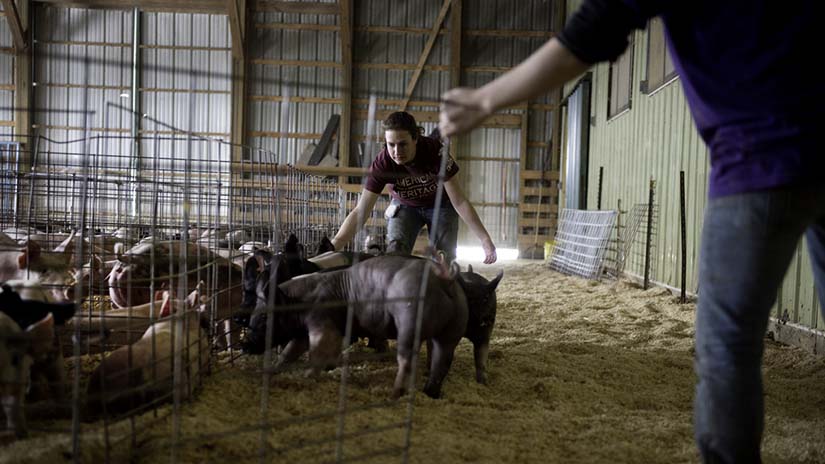
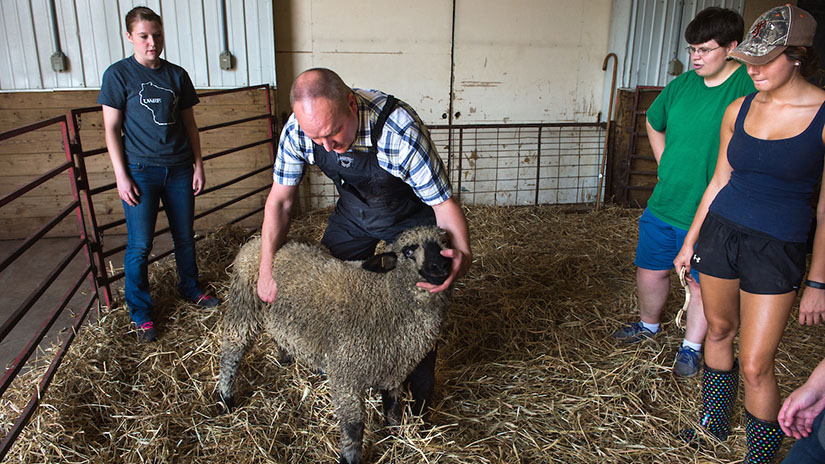
CAFES maintains two laboratory teaching farms. Both the Mann Valley Farm and the Campus Farm are heavily utilized for course work by the animal science faculty and offer heated indoor space on-site where classes, workshops and contests and conducted. These farms include dairy, beef, swine, sheep, poultry and equine enterprises.
Valuable practical experience in animal production may be gained by obtaining a job at one of the laboratory farms. Students work with dairy, equine, or livestock enterprises supported by work study, student assistant or research funds. Opportunities also exist for junior or senior level students to experience a higher level of responsibility by managing the beef, swine or sheep enterprises at the laboratory farms.
In addition, the Animal and Food Science Department operates an on-campus dairy manufacturing plant and a fully-equipped meat processing facility where students learn the skills, techniques and safety/health regulations they need for a career in the animal foods processing industry.
Both the farms and the pilot plants provide an opportunity for students to engage in hands-on activity, helping our graduates easily transition into the working world.
Contact Us
Animal and Food Science
anfdsci@uwrf.edu
715-425-3704
242 Food Science Addition
590 S. Spruce Street


