UNIVERSITY OF WISCONSIN River Falls


Notable Visitors
1930s
| Year/Mo. | Visitor | Event Description |
|---|---|---|
|
1931 January |
Fisk Jubilee Singers |
Performance: River Falls was one of only four schools in the Northwest honored with a concert by the sextet of two women and four men, all graduates of Fisk University [sponsored by the Music Department] |
|
1932 January |
William Lee Trio |
Performance: The Trio came highly recommended by the extension division of the University of Minnesota. The trio is composed of a tenor, pianist, and violinist. The violinist was regarded as one of the world's great violin teachers. |
|
1932 February |
T. C. Harris |
Lecture: Harris talked on the prevention of war, addressing the joint session of the YMCA and YWCA; the lecture was open to students, faculty, and community |
|
1932 March |
Phillip F. La Follette |
Speech: Governor La Follette said the nation should soon be a leader in national emergency relief, "It is the function of the nation, not local communities, to meet national emergencies." One thousand Pierce and St. Croix county voters and students packed the college auditorium to overflow |
|
1932 April |
Theodore Christianson |
Speech: Christianson, former governor of Minnesota, addressed the student body at an assembly about "Good Citizenship" |
|
1932 April |
Charles Lofgren |
Antarctic Perils: Forty-two men practically marooned at the South Pole, 2300 miles from civilization was the situation of Commander Byrd's company according to Charles Lofgren in his address. It was very cold at the Pole, one could see their own breath freeze and the kerosene had to be thawed out. It was 72 degrees below zero. The average winter temperature was 45-50 degrees below zero. |
|
1932 May |
Mahon Raj |
Gandhi: "Understanding and sympathy are two of the greatest peacemakers in the world. They tend to create an international mind," said Raj. He spoke to students at a special assembly on the general economic and political situation in India. He reviewed the life of Gandhi, saying, "Life is an opportunity for service." |
|
1932 September |
Welch Imperial Singers |
Performance: The outstanding international group made their appearance at the college auditorium. The organization is composed of twelve singers, an accompanist, and a conductor. They were costumed in red swallow tailed coats, puffed shirts, black slacks, and tight trousers. Their recital was received by a large audience. |
|
1933 January |
Maulana Shaukat Ali |
Lecture: He shared the political views of Gandhi, other Indian leaders, and himself, stating how his beliefs differ; the lecture was held in the college auditorium |
|
1933 February |
Dr. Ambrose L. Suhrie |
Lecture: "Problems in Teacher Training," Dr. Suhrie was a guest of the faculty and students at River Falls; he was a member of several education organizations, and associate editor of the New Jersey Journal of Education; he edited volumes V and VI of Problems in Teacher Training, published in 1932 |
|
1933 March |
Dr. Leroy |
Plays From 1933: The critic named "Alice in Wonderland" as best comedy of the year and "Lucrece" as best tragedy. Dr. Leroy gave a critical discussion in the River Falls Social Room. He commented on this year's dramatic productions as being better moral plays than last year's. |
|
1933 October |
Dr. Nels Bengston |
Lecture: "Lights and Shadows in Caribbean America," Dr. Bengston gave his lecture at an assembly, the main focus of which was life in Central America; he had considerable experience traveling through parts of Central and South America as well as Norway |
|
1934 January |
Dr. A. E. Jenks |
Lecture: "Minnesota Man," In his address to an assembly, Dr. Jenks lectured on the finding of the Minnesota Man. He explained, the Minnesota Man was not a man, but a sixteen year old girl. |
|
1934 February |
Frederich Snyder |
Current Topics of Interest: Snyder, a noted New York newspaper man was designated as a special commissioner of the Press Congress in 1925 |
|
1934 September |
Arthur Frazer, pianist, and |
Performance: The program had both educational value as well as entertainment for it covers much of the history of dance. Arthur Frazer, the musical director is a concert pianist with wide experience in recitals. |
|
1934 October |
Helen Wyman |
Lecture: "Mexico," Mrs. Wyman observed that Mexicans are a hard-working people; that Mexico is considered a land of contrasts, with deserts in the north and tropical jungles in the south; and that the real Mexico is found in the small villages |
|
1934 October |
Geoffrey O'Hara |
Performance: O'Hara gave a talk focusing on songs he composed such as, "There Is No Death," "K-K-K-Katy," and over 150 other popular songs he composed |
|
1934 November |
Dr. Cyrus P. Barnum |
War Incidents: Barnum tells of a German air raid the World Court has little strength to enforce. He discussed the horrors of war through his experiences in London. |
|
1934 December |
Dr. W. A. O'Brien |
Lecture: "Life at Forty," Dr. O'Brien focused on life at forty, presented in the college auditorium |
|
1935 January |
Leonard J. Cromie |
Lecture: Cromie lectured on "Phases of Economic and Political Trends in the World Today"; he has just returned from Paris on a two-year study of national and international affairs; the lecture was held in an assembly |
|
1935 February |
Dr. L. W. Boe |
Lecture: European Travels, Dr. Boe lectured at assembly at River Falls. Dr. Boe has made several trips to Europe and interviewed many foreign leaders with emphasis on German conditions. [sponsored by the River Falls Citizens' Council] |
|
1935 February |
Dr. Justin Williams |
George Washington: Dr. Williams spoke at assembly in celebration on Washington's birthday. He focused on discussing the life of George Washington, first President of the United States. His speech took place in the North Hall auditorium. This assembly was open to the public. |
|
1935 March |
James Featherstone |
Band Concert: The Concert Band gave the third annual performance. Featherstone was a guest artist. The program included numbers ranging from classical music to selections from popular musical comedies. |
|
1935 September |
Gertrude Overbee |
Performance: Mrs. Overbee, from Northfield, Minnesota, entertained with a group of songs at a regular assembly. The program consisted of several types of songs including opera selections, folk songs, Finnish and German numbers, and Italian songs. Miss Wharton accompanied at the piano. |
|
1935 October |
Charles Eagle Plume (Charles F. Burkhardt) |
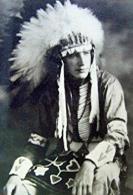
Presentation: Charles Eagle Plume, wearing authentic and beautiful costumes, presented his program of songs and dances "packed full of Indian lore and history" |
|
1935 October |
J. Franklin Caveney |
Chalk Talker: Cartoons, landscapes, and informal comments were presented. Caveney featured rapid-fire sketches from life, landscapes, caricatures, and comment. He tosses a bit of clay on a board and quickly pats and presses it into a droll creation or image of some great personage in history. He also sketched a resemblance of someone in the audience. |
|
1935 October |
Siegfried Vollstedt, conductor and pianist, and |
Performance: The married musical artists performed before a full audience--They were husband and wife. They came highly recommended by Egon Pollack, music director of Hamburg Opera and conductor of the Chicago Civic Opera. |
|
1935 November |
Arthur D. Carpenter |
Astronomy: Mr. Carpenter gave his presentation at the college assembly. He dealt with astronomy and related sciences. He routinely discusses science in a language most can understand, thus making him a successful interpreter of science. He has been listed in the "Who's Who in American." |
|
1936 April |
Rudolph Reiners |
Performance: Reiners, a well-known concertist, has wide experience in music. He has had musical training in the schools of America and Europe and has had successful concert appearances on both continents. |
|
1936 July 15 |
Philip F. La Follette |
Speech: Wisconsin's governor spoke at the River Falls State Teachers College on the need for better education in Wisconsin |
|
1936 October |
Captain Carl Von Hoffman |
Lecture: Von Hoffman presented some of his views and experiences in Africa at the assembly period, informing the audience that the people he became associated with are good people who live a different way of life; a movie of one of his books, "Jungle Gods," illustrated his talk of life in Africa |
|
1937 January |
Edgar Doudna |
Germany: Doudna gave an address to the students of River Falls. He spent six weeks observing German schools under the Hitler regime. He said, "Most German people believe him to be the savior of their nation." It was the compelling power of Hitler's personality. The German people were outraged over the poor state of their economy. |
|
1937 February |
Edward Bradley |
Lecture: Bradley spoke at a college assembly, discussing the significance of youth movements in democratic countries as well as Germany, Italy, and Central Europe. Also, the influence of the universities on current trends. The dominant role among youth is nationalism. Pacifism is totally absent from discussions. |
|
1937 March |
Captain Hasslet |
Arctic Experiences: Captain Hasselt met with the History Club to discuss the experiences of him and his associates during their several days stay in the arctic regions. They consumed food they brought and refrained from killing the wild animals. They realized that the animals, like themselves were putting up a brave struggle to survive. |
|
1937 April |
Robert Reed |
Boulder Dam and the Metropolitan Aqueduct: Mr. Reed's main focus was the huge 220 million dollar aqueduct which will consist of 335 miles of hard rock tunnels. |
|
1937 November |
Sidney Montague |
Science Cannot Explain the North: Montague spent four years in the region north of Hudson Bay as a Canadian Mountie. He described life there and discussed he culture of the Eskimo. Life in this area is foreboding, but the Eskimo knows more about the arctic that outsiders do, including science. "It is the Eskimo who has taught scientists what they know of the North." |
|
1937 May |
Alvin Hanson, Harold Quigley, A. N. Christenson, Paul Minault |
Lecture Series: Eminent lecturers addressed the River Falls college symposium by the History department. Professor Alvin Hanson, economics; Professor Harold Quigley, political science; Dr. A. N. Christenson, political science; and Dr. Paul Minault, French: all spoke at the symposium. [sponsored by the History department] |
|
1938 November |
Dr. Gustav Grahn |
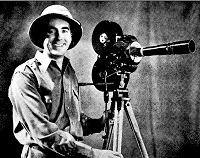
Lecture: "In Lion Land with the Movie Camera," Grahn presented his African adventures in motion pictures of "exciting battles with the beasts of the jungle, primitive savages in weird ceremonies and native dances" in some of the world's wildest and most inaccessible regions [sponsored by the Assembly] |
|
1939 January |
Rev. Arthur Johnson |
Jewish Trends and Activities in Palestine: The question: Will Palestine be the cause of another world war?, Will the Jews return to Palestine?, and many others were addressed during the assembly |
|
1939 March |
Coffer Miller Players |
Performance: The Players presented a three act play, "The Kings Dilemma," about the reign of King Henry VIII; the comedy is based upon some of the lighter events in the life of England's most married king |